Availability
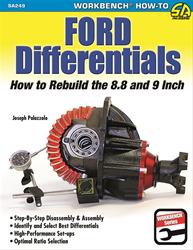
This Workbench title: Ford Differentials, How to Rebuild the 8.8 and 9 Inch, provides detailed step-by-step photographs and information for rebuilding the 8.8 and 9 in. differentials with the best equipment, installing the gear sets, and converting to Posi-Traction for a variety of applications. It explains how to select the right differential hardware, bearings, seals, and other parts, as well as how to set ring and pinion backlash so that the rear-end operates at peak efficiency. The book has a how-to section for disassembling the rear-end, identifying worn ring and pinion gears, and other damage or wear. It also covers axle identification, inspecting and purchasing axles, differential teardown, ring pinion gear removal, drive axle choices, and more.
( 15 )
$25.79

This Workbench title, Ford AOD Transmissions: Rebuilding and Modifying the AOD, AODE and 4R70W, walks you through the rebuild process step-by-step, from removing the transmission from the vehicle to complete disassembly, cleaning, and careful reassembly, to proper re-installation and road testing. Author George Reid also shares insightful information on performance modifications, as well as an ID guide for various model numbers, shift kit installation, evolutionary design changes, and torque converter selection. So, if you plan on researching or working on any one of these overdrive models, add this must-have book to your workbench or automotive library. Knowledge is power!
( 4 )
$25.79

Build and modify your 1967-1972 Chevrolet or GMC truck utilizing today's greatest parts. The 1967-1972 GM pickups are American icons. They've been popular for decades due to their simple nature, stout engine options, crisp styling, and fantastic reliability. However, you can make a classic pickup drive, stop, and look better than it ever did from the factory. Longtime magazine editor Jim Pickering dives into all the factors that made these GM trucks so popular, as well as the modifications that bring a modern spin to their classic look and feel. He takes a close look at all of the major systems in your truck and covers the ways to upgrade those systems. These upgrades make your truck quick, safe, stylish, and reliable enough to drive across the country or over to your local cruise-night diner. The market has caught onto these trucks (with high prices to match), but you don't have to break the bank to find a good one if you know where to look and what to look for. This book covers a lot of ground—from sourcing a great starting point, to the inevitable rust repair that you'll have to tackle before the real fun begins. From there, the book covers powertrain options, including LS and LT swaps, overdrive automatic and manual transmission installation, hydraulic clutch conversions, and 12-bolt axle rebuilds. Also covered are coilover and air-bag suspension installation, exhaust systems, big brakes, tight steering, making all new steel high-pressure fuel lines, aftermarket wheels and tires, and more. Aesthetic upgrades include converting from a long bed to a short bed, patina paint application, cooling-system upgrades, interior rehabilitation, LED lighting, and air-conditioner installation. "Chevy/GMC Trucks 1967-1972: How to Build and Modify" is a valuable resource, whether you do the work yourself or you want expert advice regarding items to upgrade before hiring a professional.
Not Yet Reviewed
$22.79

In an era before corporate average fuel economy (CAFÉ) requirements and emissions standards, a pioneering General Motors executive was tasked with taking over a dying division and returning it to profitability. In June 1956, Semon E. "Bunkie" Knudsen became the general manager of the Pontiac Motor Division. He injected the stodgy, boring product line with a large dose of performance. "Race on Sunday; sell on Monday" was Knudsen's philosophy. Although the idea of Pontiac getting into racing was far-fetched in 1956, Knudsen had a plan. In 1957, Pontiac released the Bonneville, which was a limited edition, fuel-injected, high performance convertible aimed directly at the burgeoning enthusiast market. Knudsen skillfully crafted a new youthful persona for Pontiac, and the sales began to climb. Pontiac's Super Duty factory-built drag cars produced an amazing line of winners. The performance mentality was clearly working, as Pontiac sales jumped to third place among the manufacturers—behind only Chevrolet and Ford. After GM ceased all racing activities in 1963, Pontiac hardly missed a beat. In 1964, the GTO was released, and a new market segment (the muscle car) was born, which sent the competition back to the drawing boards. In addition, Pontiac continued to create iconic muscle cars, including the 2+2, the Ram-Air GTO and Firebird, the Trans Am, the Judge, and the Firebird Formula. Re-live Pontiac's golden era with "Pontiac Performance 1960–1974: The Era of the Super Duty, H.O., and Ram Air Drag and Muscle Cars." This 160-page paperback contains 329 illustrations and is a must-read for classic car enthusiasts!
Not Yet Reviewed
$24.99
Modal Header
 Truck / SUV
 Jeep®
Jeep®
 Restoration
 Stock Replacement
 Late Model Muscle
 Tools
Tools
 Gifts, Clothing, & More
 Circle Track
 Street Rod
 Powersports
 Paint & Body
 Marine
 Jr Dragster