 Truck / SUV
 Jeep®
 Restoration
 Stock Replacement
 Late Model Muscle
 Tools
 Gifts, Clothing, & More
 Circle Track
 Street Rod
 Powersports
 Paint & Body
 Marine
 Jr Dragster
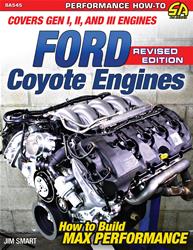
How to Build Max Performance Ford Coyote Engines
Book, "How to Build Max Performance Ford Coyote Engines", 160 Pages, Paperback, Each
See More Specifications
Estimated Ship Date: Today Would you rather pick it up?
Overview
Brand:
Manufacturer's Part Number:
SA545
Part Type:
Product Line:
Summit Racing Part Number:
SAD-SA545
Item Number:
7481147
UPC:
9781613257982
Author:
Jim Smart
Pages:
160
ISBN:
978-1-61325-798-2
Binding:
Paperback
Quantity:
Sold individually.
How to Build Max Performance Ford Coyote Engines
Realize your Ford Coyote engine's full potential by using this detailed resource as a guide to select the right parts for the street or the strip. Veteran Ford writer and historian, Jim Smart, explains and highlights all of the latest and greatest options to achieve more horsepower and torque—and of course, faster quarter-mile times— in "Ford Coyote Engines: How to Build Max Performance."
In this Revised Edition, now covering Generation III engines as well as Generation I and II, upgrades included are engine building techniques, cold-air induction kits, supercharger and pulley kits, better exhaust headers, fuel system and ECU tuning upgrades, and more. Both Ford and the aftermarket have produced an array of parts to squeeze even more power out of your Coyote.
Ford introduced its first "clean slate design" V-8 engines in the early 1990s in Ford, Lincoln, and Mercury models. Known as the "Modular" engine family, the 4.6L engines employed new overhead cams, multi-valve performance, distributor-less ignition, and more. This engine had new technology for its time, and it proved to be an extremely durable workhorse that logged hundreds of thousands of miles in police and taxi applications, as well as light-duty trucks. And, of course, hotter versions and even supercharged versions found their way into performance applications such as Mustang GTs and Cobras.
By 2011, Ford wanted something hotter and more current, especially for its flagship Mustang GT and GT350 models—which were suddenly competing with new 6.2L LS3 engines in Camaros and 6.4L Hemi engines in Challengers. Enter Ford's new 5.0L "Coyote" engine with Twin Independent Variable Cam Timing (Ti-VCT); it was an evolution of the earlier 4.6L and 5.4L Modular designs. Although the new Coyote engine had increased displacement, it still had far fewer cubes than the competition. Despite less displacement, the Coyote could hold its own against bigger Chevy and Chrysler mills, thanks to advanced technology such as 4V heads with better port and valvetrain geometry. The Coyote is also Ford's first foray into technology that includes Ti-VCT and cam-torque-actuated (CTA) function, which is a fancy way of saying variable cam timing for an incredible power curve over a broader RPM range. Now, in Generation III, Ford has implemented a system using both Port and Direct Fuel Injection, taking advantage of the benefits of both systems in a single application.
Even with all of this new technology, there is always room for improvement. If you're looking for even more power from your new Coyote, you'll find answers in the 160-page paperback from SA Design and CarTech. More than 580 color photos are included.
Loading...
Questions & Answers
Ask a Question
What type of question would you like to submit?
I have a Customer Service question
(order, shipping, returns, protection plans, etc.). Customer Service Question
(order, shipping, returns, protection plans, etc.). Customer Service Question
- OR -
I would like to ask other customers
a question about this Product. Product Related Question
a question about this Product. Product Related Question
Loading...
Reviews Write a Review
Some parts are not legal for use in California or other states with similar laws / regulations
Call To Order
This is a custom order part. You can order this part by Contacting Us.

Email this page