 Truck / SUV
 Jeep®
 Restoration
 Stock Replacement
 Late Model Muscle
 Tools
 Gifts, Clothing, & More
 Circle Track
 Street Rod
 Powersports
 Paint & Body
 Marine
 Jr Dragster
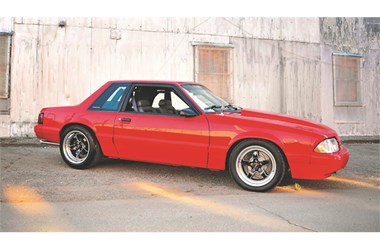
If there is truly a jack-of-all-trades car, the Ford Fox body Mustang may just be it. It’s just so darn easy to build a street machine, drag racer, autocrosser, or road racer out of a Fox. And talk about popular—Ford produced over 2.6 million of the cars between 1979 and 1993, meaning that every fourth Mustang ever made was a Fox body. The cars are still easy to find and you won’t have to mortgage yourself to the hilt to buy one.
Keep in mind, however, that the Fox body is an old car now. While it was considered a decent handler in its day, a modern minivan probably corners better than a stock Fox. Add in age and use and you better believe that the factory bushings, ball joints, shocks, and springs on most Fox Body Mustangs are long past their prime.
You could settle for an OE-spec rebuild using parts designed when This is Spinal Tap played at the local drive-in. Or you can crank the fun meter up to eleven with road- and track-proven QA1 performance suspension components. Why QA1? Because the products are built to exacting specifications from high-quality materials and bolt into the factory locations without any fuss.
Moreover, QA1 parts can be installed all at once or in stages. For instance, if you find that every part of your suspension is toast, you can replace the whole shebang in one fell swoop like PowerNation TV’s Detroit Muscle did with the Sydewinder 1981 Mustang Cobra. You can also build your car in stages as your budget allows. What’s great about this method is that you can keep driving your car as you make upgrades since QA1 products work seamlessly with the factory parts.
Follow along as we show you how QA1 can help you get the most bang for your buck from your Fox body.
Adjustable Shocks and Struts
The single biggest improvement you can make to ride and handling is a set of adjustable shocks and struts. QA1's Stock Mount Shocks and Struts feature on-the-car adjustable valving with 18 clicks of compression and rebound adjustment to make it easy to dial in your desired level of comfort and performance.
Case in point: Say you want to compete in an autocross. For the drive to the event, you can set the dampers to a softer setting for a more supple ride. At the track, dial-up the settings to stiffen the shocks to keep body roll to a minimum and the tires in contact with the road. When the racing’s over, reset the shocks to your street settings and cruise home in comfort. That’s the real beauty of adjustable shocks and struts—it’s like having several suspensions in one.
So how do you choose which model of shock is right for you? It’s simple. If you want to improve handling on a car that’s primarily driven on the street, choose single-adjustable shocks. Weekend drag race cars work best with single-adjustable “R” front struts (not recommended for street use). If you spend most of your time on an autocross course, road racing, or at the drag strip, go with double-adjustable shocks and don’t look back. You’ll find that all of these QA1 shocks and struts work best when paired with stock-style springs.
Coilovers
People who want to substantially reduce lap times or give their cars a more aggressive stance will want QA1 Coilover Shocks and Struts. Coilovers offer the same options and 18-way adjustability that QA1’s regular shocks offer, but they can also lower a vehicle’s ride height by more than two inches. This will lower the car’s center of gravity for improved handling, aid in faster turn in with reduced body roll, and allow the car to transition side-to-side quicker and more predictably. Different rate springs are available so you can fine-tune your car for your preferred driving style.
QA1’s handy Spring Rate Calculator makes choosing coilover springs easier. QA1 did the research, identifying and cataloging the springs that work best on Fox body vehicles. Choosing the correct spring rate is simply a matter of matching the vehicle weight and driving type to the available spring rates. There is even a video that explains the ins and outs of choosing the correct springs.
Caster/Camber Plates
Caster/camber plates are the plates you see sitting on top of the strut tower housings inside a Mustang’s engine compartment. Their job is to connect the top of the front strut to the vehicle body. Over time, the bushings in the factory stamped steel plates wear, dry rot, and become brittle, resulting in poor wheel alignment and increased road noise.
QA1 Caster/Camber Plates feature fully TIG welded construction and spherical bearings for the ultimate in strength and durability. An asymmetric bearing specifically engineered for this application significantly reduces wear. With these plates on your car, you’ll be able to run a more aggressive alignment than what is possible with stock mounts. Aligning the car after lowering the ride height will be much easier too.
New Tires and Wheels
Part of the fun of upgrading your Fox’s suspension is choosing a new set of rolling stock. This stage of suspension upgrades is as good a time as any to install wider wheels and sticky tires. Just keep in mind that you will need additional QA1 parts to get the most from them. Read on.
Tubular Anti-Sway Bar Set
If you’ve made all of the upgrades outlined thus far, you will notice that the factory anti-sway bars have a hard time controlling the extra g-forces your new suspension is capable of producing. Now is the perfect time to install QA1 Tubular Anti-Sway Bars. The diameter of the sway bars has been carefully selected and optimized for the Fox body platform. Made from 4130 chromoly steel, the 1 ¼ inch front and 1 inch rear bars give the car a positive, balanced feel in the corners by decreasing body roll and keeping the tires firmly planted on the road. Your car will plant the rear tires harder during drag-style launches, and adjustable end links let you customize roll stiffness to your personal specifications. The bars include greaseable graphite polyurethane bushings along with high-quality zinc-plated mounting hardware.
Front Tubular Control Arms
Control arms are the next major upgrade on the road to handling nirvana. The factory control arms were built with soft rubber bushings that helped smooth the car’s ride and reduced the amount of NVH (noise, vibration, and harshness) transmitted into the cabin. And in true OEM-fashion, the arms are stamped from heavy gauge steel yet still manage to flex like a wet noodle under load. That mean, equipped with factory control arms, your Fox body will never reach its true potential in the corners.
QA1 Tubular Control Arms can fix that. These arms are much stronger yet weigh 15 pounds less than their factory counterparts. QA1 revised the arm’s geometry to allow for additional camber and caster adjustments so you can dial-in an alignment that’s guaranteed to help your car stay true in a straight line and keep the tires flat on the ground during hard cornering.
The control arms are available in two configurations—street and race. The street arms use a factory-style replaceable ball joint for easier serviceability and polyurethane bushings for a smooth ride with reduced binding. The race arms are meant for drag racing, Pro-Touring, and autocross applications. They’re equipped with QA1’s exclusive X-Series chromoly rod ends and low friction ball joints that provide a wider range of alignment settings and reduce friction in the front suspension.
QA1 hasn’t forgotten about those of you who have upgraded to SN95 brakes either. QA1 control arms are available with Fox body or SN95 spindle mounting points—just specify which design you need when ordering.
Rear Trailing Arms
You can’t—or really, shouldn’t—make a big change to the front suspension without upgrading the rear trailing arms. Just like the factory front arms, the OEM rear trailing arms are made from weak, flex-prone stamped steel with soft rubber bushings that bind during suspension compression. That leads to unpredictable cornering and bad launches. Once again, QA1 has your solution. Its Rear Trailing Arms feature non-adjustable lower and adjustable upper designs to improve your driving experience. The non-adjustable, boxed lower trailing arms are constructed from ultra-strong, .120 inch thick cold rolled steel tubing to handle whatever horsepower you can throw at them. Fluted greaseable, graphite polyurethane bushings are superior to the slop-happy OEM rubber bushings, and won’t bind or flex during hard launches or aggressive handling maneuvers.
The adjustable upper trailing arms are a work of art. Tubular in design, they’re made with an aluminum center section to shave some weight off the rear of the car. The adjustable design allows easy rear suspension adjustment for optimum handling and traction. QA1 was careful to design them so they can be adjusted without removing the arms from the vehicle; simply loosen the jam nuts and turn the arm to alter the pinion angle. Greaseable graphite polyurethane bushings replace the soft OE rubber differential bushings. On the chassis end, greaseable spherical ball assemblies with UHMW bushings (Ultra High Molecular Weight Polyethylene—an extremely tough plastic with high abrasion and wear resistance) allow the rear suspension to move freely for better car control.
Tubular K-Member
Why is the factory K-member bad? It’s heavy, yet not stout enough to prevent the front suspension assembly from moving around when the car is pushed to its limits. This causes suspension bind, fouls up the wheel alignment, and causes the car to handle erratically. Not good.
A QA1 Tubular K-Member is made from high-strength, low-alloy (HSLA) tubular steel that makes it much stiffer than the factory part. That means more precise and predictable steering, less bump steer, reduced dive under braking, and quicker straight-line performance. The QA1 K-members are also 50% lighter (around 25 pounds) than the factory setup. Sounds like a win-win in our book.
Another advantage of QA1 K-member’s tubular construction is that it creates additional space for oil pan and header clearance. That’s a big deal since engine swaps are all the rage these days. The extra room around components makes maintenance easier, too. You can get your QA1 K-member with factory 5.0L Ford engine mounts, GM LS mounts, or without mounts for custom engine installs. The mounts are a bolt-in design; if you decide later that you want to run a different engine type, you can simply switch the mounts instead of bolting in a new K-member. That’s pretty neat-o.
If you are wondering why we recommend this upgrade last, it’s because QA1 recommends that it be used on lowered vehicles (see the Coilovers section) and on cars that have already been upgraded with QA1 Tubular Control Arms. Now you know.
The End
So, there you have it—a complete guide to proven QA1 Fox Mustang suspension upgrades for everyone from street cruisers to track day warriors. It’s like helping an old friend run marathons again!