 Truck / SUV
 Jeep®
 Restoration
 Stock Replacement
 Late Model Muscle
 Tools
 Gifts, Clothing, & More
 Circle Track
 Street Rod
 Powersports
 Paint & Body
 Marine
 Jr Dragster
This month's Ask Away deals with two topics all of us have encountered at one time or another--hesitation under acceleration and needed a boost in engine compression to make more horsepower. Of course, our friend Jeff Smith has helpful advice on curing the first problem and fixing the second.
A Step-by Step Guide for Curing Hesitation
M.A. has been helping a neighborhood kid with his small block-powered 1969 Chevy C10. The current issue is hesitation under hard acceleration. The 350 has a Holley carburetor on an aftermarket aluminum intake manifold. The transmission is the typical TH-350.
Mr. Smith provided a step-by-step guide to finding the source of the hesitation and fixing it:
* Check ignition timing
* Stabilize the carburetor's idle mixture
* Check accelerator pump linkage for binding
* Check for blown accelerator pump diaphragm
* Check accelerator pump arm and nozzle
The devil is in the details, of course--you'll have to read the article to find the correct procedures.
Increasing Engine Compression on the Cheap
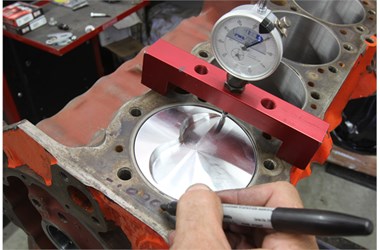
J.H. has a small block Chevy 350 with iron heads and the usual bolt-ons. The engine runs fine, but he would like to up the compression ratio and make some extra power, but he doesn't have much money to spend. A conundrum, to be sure.
Jeff's down and dirty idea is to decrease the quench area--the flat portion of the piston that matches the flat portion of the combustion chamber on a wedge type cylinder head--by reducing deck height (the space between the block deck and the piston in the cylinder bore). The easy and inexpensive way to do that is with a pair of thinner, steel shim head gaskets. Jeff explains the hows and whys in the article.