 Truck / SUV
 Jeep®
Jeep®
 Restoration
 Stock Replacement
 Late Model Muscle
 Tools
Tools
 Gifts, Clothing, & More
 Circle Track
 Street Rod
 Powersports
 Paint & Body
 Marine
 Jr Dragster
What are Ask Away with Jeff Smith readers, er, asking about lately? Clutch pedal effort and understanding EFI fuel system requirements, it seems. Let's find out.
Comparing Pedal Effort Between Hydraulic and Mechanical Systems
Our friend M.S. asks:
"Does a hydraulic system make the clutch pedal effort easier than a mechanical linkage? A friend of mine says the effort will be the same because all the force is from the pressure plate that has to hold the clutch. Is that true? The clutch pedal in my ‘71 Chevy truck is very stiff and I’d like to fix that."
Jeff says it's a common misconception that a hydraulic system will reduce the pedal effort. The load required to press in the clutch pedal is based almost entirely on the load created by the pressure plate. Lighter clutch pedal effort is mainly due to using a softer pressure plate.
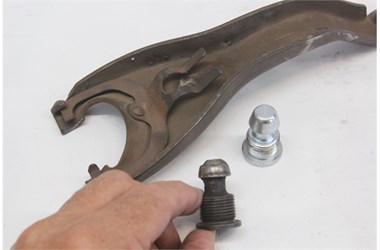
As for the stiff clutch issue, Jeff says there is likely a problem with your mechanical system that is creating the higher effort. Things to look at are the release arm and the ball stud inside the bellhousing the release arm pivots on.
Matching Fuel Pumps, Fuel Lines, and Injectors for Maximum Power
J.C. has a serious question on EFI fuel systems:
"I need help understanding EFI high pressure fuel systems. I’m trying to build a Whipple Supercharged small block Chevy 427 c.i.d. engine with approximately 8 PSI of boost and a 700 horsepower FAST XFI System. I just purchased a Walbro 525-liters per hour, in-tank fuel pump. I plan to use the existing 3/8 inch line for a return and install a new supply line.
I should have the pressure needed, but what determines volume and line size? Larger hose for more fuel and power doesn’t seem to be the case with EFI. I’m using the formula 700 HP x .75 = 525 lbs./hr. divided by 6.2 lbs./gallon = 84 GPH. If this is correct, how do I get more horsepower from high pressure which would mean a lower volume of fuel?"
According to Jeff, J.C.'s math on the fuel pump size is good. With 700 horsepower you multiplied it times the brake-specific fuel consumption (BSFC) number to get 525 lbs. of fuel. BSFC is defined as the pounds of fuel per horsepower per hour consumed by an engine. As the BSFC numbers get larger, this means the engine uses more fuel to make the same power.
Jeff continues by saying that running a larger fuel line will result in less pressure drop over the length of the line, meaning the fuel pump doesn't have to work as hard to maintain fuel pressure.
There is a lot more to this story, so make sure to read the article at OnAllCylinders carefully.