 Truck / SUV
 Jeep®
Jeep®
 Restoration
 Stock Replacement
 Late Model Muscle
 Tools
Tools
 Gifts, Clothing, & More
 Circle Track
 Street Rod
 Powersports
 Paint & Body
 Marine
 Jr Dragster
News & Events
Featured Vehicles
Feb 8, 2004
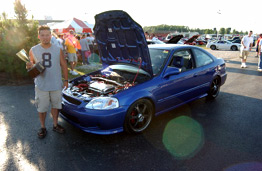
Blue Bullet Si: Mike Gbur's 2000 Honda Civic Si
The ponycar-era effectively began when the first Mustang rolled off the assembly line in 1964. It unceremoniously ended in the mid-1970s with the passage of stricter emissions laws and the demand for smaller, more fuel-efficient cars.
Ironically, it’s those same compact cars that have ushered in a new era of high performance—as evidenced by cars like Mike Gbur’s 2000 Civic Si. “It’s the modern day Mustang,” Mike said, referring to his Si. “And now it’s my dream car.”
Before he could make such a bold comparison between his Civic Si and Ford’s quintessential ponycar, Mike knew he’d have to be able to back it up. The Cheswick, Pennsylvania resident had the Honda’s stock 1.6L outfitted with Darton cylinder sleeves, then had the cylinder head ported and polished to pave the way for some serious power.
Sep 1, 2000

Iron Man: Jay Porter's 1964 Pontiac GTO
Jay Porter is an ironworker for Local 17 in Akron, Ohio. And as everyone knows, a guy with a he-man job like that can’t be seen driving some tin can weenycar. No sir, Jay maintains his iron man rep by driving an asphalt pounding, hydrocarbon-swilling piece of Detroit steel—a 1964 Pontiac GTO.
Jay comes by his GTO jones honestly. Dear Old Dad drove nothing but Goats when he was growing up, and Jay’s had four GTOs of his own over the years, including a ’70 Ram Air 455.
And being from Middle America, he also caught the Pro Street bug. Even when Pro Street was declared dead by the magazines, Jay still dreamed of a tubbed early GTO with a bad motor and an attitude to match.
He found the right candidate in 1997 in the form of a tired 1964 GTO. Over the next two years father John Porter and friends Jim Miller, Mike Jones, Jim Rose, and Paul Newman (no, not that Paul) helped Jay tear the Pontiac apart and put it back together the way he saw it in his mind’s garage.
Aug 1, 2000

Shoebox Hero: Denny Terzich's 1956 Chevy
It’s a minor miracle Denny Terzich Jr.’s head isn’t about 10 times larger than it is. After all of the ego-massaging he got over his 1956 Chevy—the one that won Goodguy’s 2002 Street Machine of the Year honors—we wouldn’t blame him for thinking he’s Master of the Street Machine Universe.
But we’ve known Denny and his dad Denny Sr. for a lot of years, and they’re the same regular guys they’ve always been. The boys are known for slick Pro Street-style rides; the roster includes three other shoebox Chevys, a ’33 Ford, and a ’62 Bel-Air bubbletop with a fuel-injected 409. The ’56 started out as a Pro Street ride too—this time for Denny Sr.—but his son convinced him to hand the car over for some major surgery.
The chassis was the first to fall under the scalpel. Denny cut out the body’s floor pan, then channeled it three inches over a home-fabbed jig. The frame was set up for Pro Street rubber, which meant it had to be redone to fit inside the body. The rear subframe was hacked off and replaced with a pair of rails from S&W Race Cars. To create a kickup in the rear, the rails were welded to the top of the remaining frame just before the rear tires. With the frame set up inside the body at actual ride height, the engine, transmission, and rear axle mounts were mocked up and pinion angles set correctly.
The ’56 gets its ground-scraping stance from a combination of S&W ladder bars, Fatman Fabrications A-arm front suspension, and AirRide Technologies Shockwave coil-overs on all four corners. Also sitting on those corners are Wilwood disc brakes and Colorado Custom Slotter Slater wheels (20 x 12 rear, 18 x 8 front) wrapped with BFGoodrich rubber.
May 1, 2000
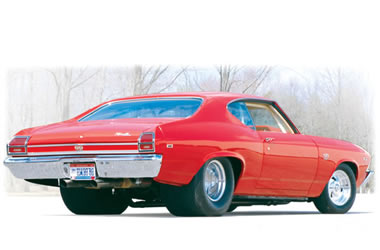
Rated Z: Mike Zayas' 1969 Chevelle SS396
This country is obsessed with rating things. Thumbs up or thumbs down. Good, better, best. Four out of five stars. From movies to soda pop, actresses’ Oscar dresses and yes, cars, we Americans love to rate our stuff.
But we had a tough time figuring out a way to rate Mike Zayas’ 1969 Chevelle SS396. With a classic Pro Street stance, a breathed-on 502 crate motor, and subtly altered body lines, the car kind of defies categorization.
Not that it matters much to Mike. He just wanted a way-cool Chevelle. “I built this car because I always wanted a Pro Street ’69,” he explained to us, ” I had a ’69 Malibu, which I sold it to build this one. I guess I love working on old cars.”
The Chevelle’s chassis is a mixture of stock and aftermarket. The stock frame was backhalfed and fitted with an Art Morrison four-link suspension and a narrowed Ford 9 inch rear axle with Strange 31-spline axles, center section, and 4.11 gears. The stock front suspension was treated to a rebuild and lowered two inches to boot. A Funny Car-style mild steel roll cage ties everything together.
Under the hood is a GM Performance 502 big block. The bottom end was left alone, but Mike replaced the hydraulic cam with a Comp Cams .584 inch lift roller cam. The 502’s aluminum heads were given a set of Harland Sharp aluminum roller rocker arms, and are covered with a set of shiny Billet Specialties valve covers. The engine came with an aluminum dual plane intake, which is topped by a 750 cfm carburetor. An Accel HEI distributor, Super Coil, and an MSD 6AL box make up the ignition system. A pair of Hedman ceramic coated headers dump exhaust gasses into a pair of three inch stainless pipes, the sound of the 502 barely subdued by two-chamber Flowmaster mufflers. A Rossler-built Turbo 400 directs 525 horsepower and 567 foot-pounds of torque back to the 33 inch Mickey Thompsons.
Mar 1, 2000

Oz-Fast: Steve McLaren's 1970 Ford TC Cortina
Q: What’s the difference between metal god/TV star Ozzy Osbourne and Australian hot rodder Steve McLaren? A: One sings at OzFest, the other drives Oz-Fast.
OK, so the joke is lousy. But Steve’s 1970 Ford TC Cortina coupe sure as heck isn’t, especially when it pulls the wind out of your lungs as he slams the AOD automatic into third and zings the 428 cubic inch 351 Windsor to seven grand. No, we didn’t get to experience it firsthand. But combine the stroker motor’s big torque, some 295/50-15 rear rubber, and a featherweight body, and it doesn’t take much imagination to figure out what the ride would be like.
Ford built the Cortina coupe in England for UK consumption only, and none were officially sold in Australia. Steve bought his from a guy who brought it over from Blighty, then spent eight years turning it into a killer street machine.
Like gearheads here in the U.S., Australians are big horsepower junkies, even though it costs them about twice as much to build it. Steve first turbocharged the Cortina’s 1.6 liter four banger, then upgraded to a two liter four. Then he got serious and transplanted a hot 302 Ford V8 into the car.
Jan 1, 2000
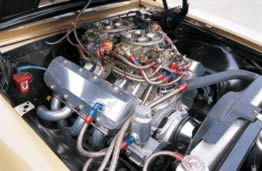
Fated: Eddie Parker's 1967 Camaro
Do you believe in fate--the idea that someone or something is out there shaping your destiny? Being worldly types, we used to equate fate with astrology, Ouiji boards, and Miss Cleo the TV psychic.
But Ed Parker has changed that. He's a respectable citizen by day, running a company that stripes asphalt parking lots in the greater Columbus, Ohio area. But on the weekends, he turns into "Fast Eddie," and tears up asphalt a quarter mile at a time in an eight-second, street-legal 1967 Camaro.
Need more proof that this man's destiny is controlled by a higher power? Ed competed in the Ohio's Fastest Street Car Shootout at Norwalk Raceway Park in 2001, where he was runner-up to event winner Gary Box. This past April, the two squared off again at Norwalk's United States Fastest Street Car Shootout (same race, new name-ed.). This time, it was Ed who tripped the win lights first to earn the title America's Fastest Street Car. If that isn't fate, we don't know what is.